
Johan Nicolás Gómez Rico
johangomez@ustavillavicencio.edu.co
Pregrado Negocios Internacionales
https://scienti.minciencias.gov.co/cvlac/visualizador/generarCurriculoCv.do?cod_rh=0001885588

Juan Diego Vargas Rojas
juan.vargasr@ustavillavicencio.edu.co
Pregrado Negocios Internacionales
https://scienti.minciencias.gov.co/cvlac/visualizador/generarCurriculoCv.do?cod_rh=0001885565

Jorge Andrés Vanegas Guatavita
jorge.vanegas@ustavillavicencio.edu.co
Pregrado Negocios Internacionales
https://scienti.minciencias.gov.co/cvlac/visualizador/generarCurriculoCv.do?cod_rh=0001886200
The relations between China and the United States have been characterized by a significant concentration in trade. At the beginning of the twentieth century, for example, the United States demonstrated its support to China – at the height of world war II – by not selling oil to Japan, setting its position regarding the Japanese invasion of the Chinese country (Gentle, 2015). The relations became increasingly intimate since the Chinese regime change in 1971, a moment that became a focal point. Such is the period where we begin to analyze the close relationship between the two countries: The visit of the United States President Richard Nixon to the People’s Republic of China in 1972 (Harding, 1992).
In the period after the visit, something very particular happened: China became a very desired place for US companies. By 1982, American companies had entered into trade relations with China solely for gaining market prestige rather than for their profitability (Tung, 1982), even though, that occurred in many countries (Foreman, 1985). Throughout the world, countries began to see China with new eyes. Multinational corporations from industrialized countries felt attracted to nations with cheap labor that were also potential markets. And this is something that China proved to have in huge quantities (Cui, Liu 2000).
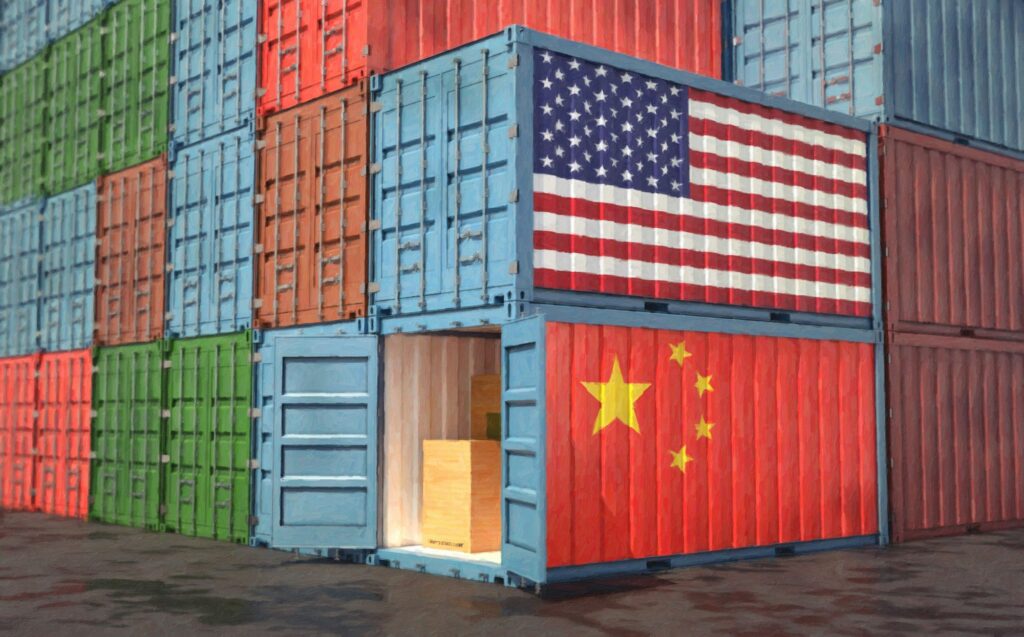
In the next 50 years, although the relationship between the United States and China has become much more volatile, it has also become more dependent on each other. In 2009, China was the third country that most bought and consumed American products and services (Wang, 2010). However, this relationship has been far from not having any problems. For a long time, there has been a very pressing issue between these two powers (Friedberg, 2005). It is defined as a new Cold War that has increased the already existing tensions on the topic of international trade.
They accuse it of stealing U.S. jobs, of keeping the yuan undervalued by pegging it to the dollar, of exporting deflation by selling its products abroad at unfair prices, of violating the rights of its workers to keep labor costs low, and of failing to meet its commitments to the World Trade Organization (WTO). (Hughes, 2005, p.01)
All these issues have been dealt with by a particular mechanism. The WTO has endeavored to properly manage disputes by defining the actions taken by both sides as bilateral, multilateral, and unilateral [SE1] (Meltzer, Shenai 2019). These matters have intensified recently since Trump’s rise to the White House. His administration imposed tariffs and other tools to discourage U.S. companies from moving their supply chain to China (Medeiros, Eva 2019), leading President Xi to take similar actions.
That is why, nowadays, a great battle of egos is taking place between these two powers. However, we must remember that the issue of tariffs for China has increased since 2010 (Loridas, 2011). Even though a very important step was taken in 2017. Chinese officials went to the EDC to seek for a dialogue related to comprehensive economy, and to request the entry of new products originating in that country (Walters, 2017). But as soon as the meeting did not render the expected results, China and the United States began a new trade confrontation.
From all the above, we conclude that the relationship between these two axes is complex and volatile and, lately, has been affected by fear. That is why the United States has imposed big tariffs that include little more than 25% of Chinese goods. China has responded with far higher rates (Liu, Woo 2018). The decisions have been diverse, and we can see that it is the most significant impetus for these measures by the United States. These efforts only demonstrate the weakness of the United States as the most significant current economic power in the face of new technologies (Chow, 2012). Therefore, today we are talking about the coronation of a new world trade regent called China.
References
Tung, R. L. (1982). US–China Trade Negotiations. New York, USA: Pergamon Press.
Loridas, K. (2011). United States-China Trade War: Signs of Protectionism in a Globalized Economy. Suffolk Transnat’l L. Rev., 34(2),403.
Medeiros, E. S. (2019). The Changing Fundamentals of US-China Relations. The Washington Quarterly, 42(3), 93-119. DOI: 10.1080/0163660X.2019.1666355
Hughes, N. C. (2005). A trade war with China? Foreign Affairs,84(4), 94-106. DOI: 10.2307/20034423
Liu, T., & Woo, W. T. (2018). Understanding the US-China trade war. China Economic Journal, 11(3), 319-340. DOI: 10.1080/17538963.2018.1516256
Gentle, P. (2015). America’s response to China: a history of Sino-American relations/Affluence and influence: economic inequality and political power in America. Asia Pacific Business Review, 21(4), 552-555. DOI: 10.1080/13602381.2014.912460
Wang, D. (2010). China’s trade relations with the United States in perspective. Journal of Current Chinese Affairs, 39(3), 165-210. DOI: 10.1177/186810261003900307
Meltzer, J. P., & Shenai, N. (2019). The US-China economic relationship. Brookings, 2-24 DOI: 10.2139/ssrn.3357900
Foreman-Peck, J. (1985). Historia de la economía mundial. Madrid, España: Ariel.
Friedberg, A. L. (2005). The future of US-China relations: Is conflict inevitable? International security, 30(2), 7-45. DOI: 10.1162/016228805775124589
Walters, R. (2017). The US–China economic relationship: Time for a change in tone. Heritage Foundation Issue Brief, (4752). Recoopered: http://report.heritage.org/bg3456
Harding, H. (1992). A Fragile Relationship: The united states and China since 1972. Washington D.C,USA: The Brooking Institution.
Cui, G., & Liu, Q. (2000). Regional market segments of China: opportunities and barriers in a big emerging market. Journal of consumer marketing,17(1), 55-72 DOI: 10.1108/07363760010309546
Chow, G. C. (2012). China as a Leader of the World Economy. Singapore: World scientific.