
Yully Gonzáles, Armando Castillo
Abstract
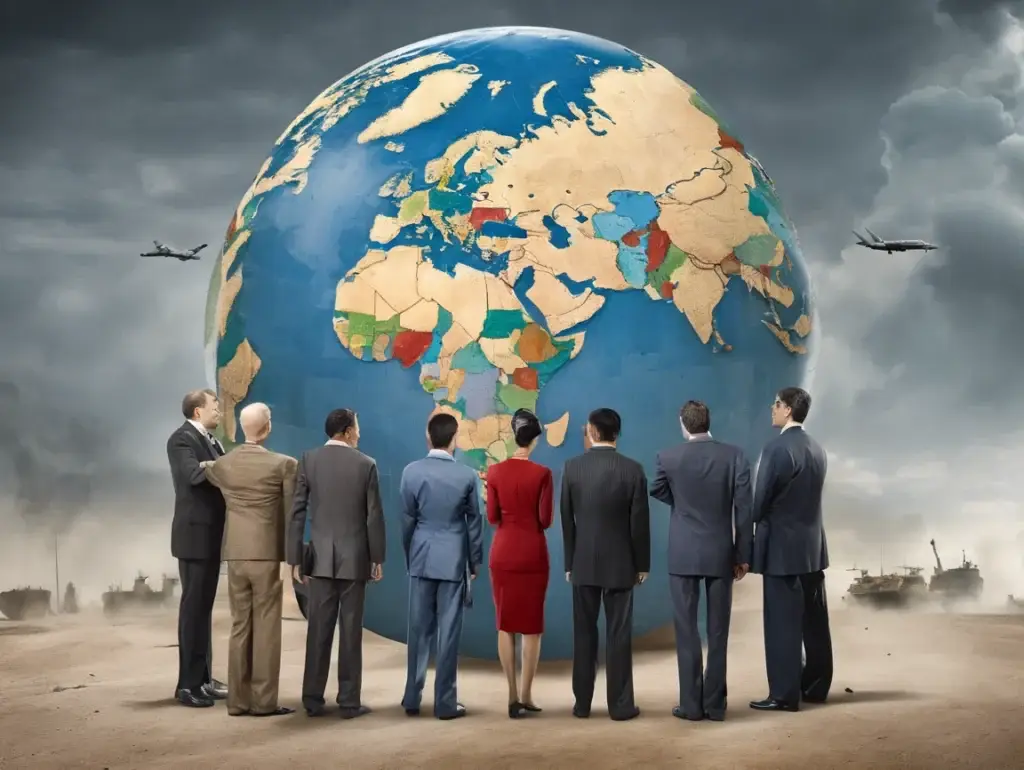
Is important to know why different conflicts are caused by and its consequences in international ambience; that is why the present writing will analyze the influence of multinational corporations in conflicts between countries, using two main actors as are United States and China; the purpose of this writing is to explain in order to conclude that the importance of corporations in International ambience can be as big as the diplomacy of a country
Introduction
To enter into the context of what a trade war generates in the field of international trade and taking into account that when a trade war occurs between two powers; The consequences can be alarming since the small companies that have sustenance through agreements and are forced to stop negotiations by multinational companies are the ones that are most affected. Many times countries decide to stop their commercial operations to protect their internal growth, but they also affect small and medium-sized companies; specially because sometimes, small and medium-sized companies depends on big countries, and with trade wars, “resources are limited, there’s not as much infrastructure and experience, and the manufacturing areas that do have infrastructure are quickly being snatched up by big-box retailers.”1 Throughout history, different trade wars have been seen, such as: the banana trade war, the oil trade war in 1986, among others. Even when multinational corporations are pressed in order to help positively in conflicts, there are some situations in which “corporations are complicit in the human rights violations of repressive governments; facilitate the international trade in commodities that finance intractable conflicts; and exacerbate societal divisions and grievances that underlie civil wars.”2
In this case we want to talk about the trade war that begins in 2018 between China and the United States, taking different themes that caused the conflict, one of them are the espionage allegations made by the U.S. congressional panel in 2012 concluding that “both Huawei and ZTE Corporation, a rival Chinese telecom company, could pose a security threat”3. Faced with this situation, different comments are made on possible cases between Huawei and the United States. The Nextgov magazine published an article where it assures and exposes the case as a trade war between China and the United States: The United States presents a regulation that formalizes the prohibition to its agencies government to make any type of negotiation with the Chinese company Huawei, establishing the rule that prevents any US federal agency, as of August 12, from making purchases of technological or telecommunications equipment from this Chinese firm.4
For its part, the United States believes that by using Huawei technologies, they open a great risk to the country’s security. A decree was signed on May 15, which establishes trade limitations, it is justified in order to protect the country from a possible economic and industrial espionage.5 One of the highlights of this dispute is a very shocking trade war for the economy of each country (United States and China). A research work done by the Argentine Sociology University concludes that so far , had been piercing the North American domain in a rather progressive way, but maintaining a relationship of complementarity. This trade war shows that the agreements between the two are not going to last long. Above all, because Chinese capitalism has an additional advantage: the state’s ability to order a course.
It is seen that world powers such as China and the United States will continue in an eternal competition for power and global recognition where each time the Chinese state will invest so that its companies are consolidated as leaders and the United States will not let its guard down with its investments and decisions strategic to stay as the world hegemon; “Behind the scenes, the “global” corporations worked closely with their home governments. These governments exercised considerable efforts to secure the interests of their companies, for example in trade access negotiations.”6In our case, United States was trying to protect its technological companies and security from the big company that was encompassing all the markets.
In addition to this, relations in general will never be easy given that China and its president Xi Jinping, with their mode of government, are carrying out a process to overthrow the United States from power. China uses unconventional strategies to remove American companies from power through buying majority shares made by the Chinese state directly, China has been threatening the United States with all the weapons that have been created to intimidate world powers, and it is no secret to anyone that China has revolutionized theories of economic development, being a guide for the other hegemons.
A clear example of power of Corporations in international relations is that even when Huawei assures that its company has nothing to do with Chinese government, a report estimated that the company had received as much as US$75 billion in state support,7 a frequently occurring event in powerful countries with big economic capacity. So the influence of big corporations in politics decisions is very important, concluding that state supports its biggest companies because they also receive benefits from it for the country’s economy, which gives them power over other countries. Here can be seen the importance of companies for international relations and diplomacy of a country, allowing them to make choices based on companies conveniences. And how the production or decisions of companies can create international conflicts or trade wars between big economies and countries. When a corporation has the power of influence into a country, the decisions taken for its benefits can even affect the international relations of the state, (such as the mentioned case of the US-China trade war), creating tense sceneries and wars, putting a proof over the diplomacy of the involved states.
References
– Haufler V. (2008). ‘MNCs and the international Community: Conflict, Conflict Prevention and the Privatization of Diplomacy. Palgrave Macmillan, London. Retrieved from: https://link.springer.com/chapter/10.1057/9780230584297_9
– Lincoln I. (2017). ‘The influence of global corporations’. Australian Institute of International Affairs. Retrieved from: http://www.internationalaffairs.org.au/news-item/the-influence-of-global-corporations/
– Reiff N. (2019). ‘Why Huawei is in the middle of the U.S-China trade war’. Investopedia. Retrieved from: https://www.investopedia.com/why-huawei-is-in-the-middle-of-the-u-s-china-trade-war-4687522
– Tao L. (2019). ‘Huawei says relationship with Chinese government ‘no different’ from any other private company in China’. South China Morning Post. Retrieved from: https://www.scmp.com/tech/big-tech/article/3043558/huawei-says-relationship-chinese-government-no-different-any-other
– Tapia I. (2019). ‘Las empresas tecnológicas y la Guerra comercial entre Estados Unidos y China. Visited Sep 19th/ 2019
– Trump D. (2019). ‘Huawei no podrá hacer negocios con el gobierno de Estados Unidos. Revista Dinero, Internacional. Visited Aug, 8th/ 2019
– Vincent, Brandi. (2019). ‘Contracting officers will have new disclosure provisions to include in contracts issued after Aug. 13’. Retrieved from: https://www.nextgov.com/policy/2019/08/federal-ban-chinese-telecom-equipment-takes-effect/159148/
– West Davis C. (2019). ‘Here’s what small businesses, slammed by China tariffs, are doing to minimize the impact of the trade war’. CNBC. Retrieved from: https://www.cnbc.com/2019/10/05/us-china-trade-war-causing-small-biz-to-reinvent-customer-retention.html
-Mar Del Plata. (2019). ‘II jornadas de sociología’. UNMdP. Visited Sep 19th/ 2019
-Pena A. (2004). ‘La Guerra commercial del plátano. Una aproximación desde la teoría de juegos. Visited Sep 19th/ 2019
-Ren Z. (2019). ‘La “extraordinaria oferta”, redacción’. BBC News Mundo. Visited Sep 19th/ 2019